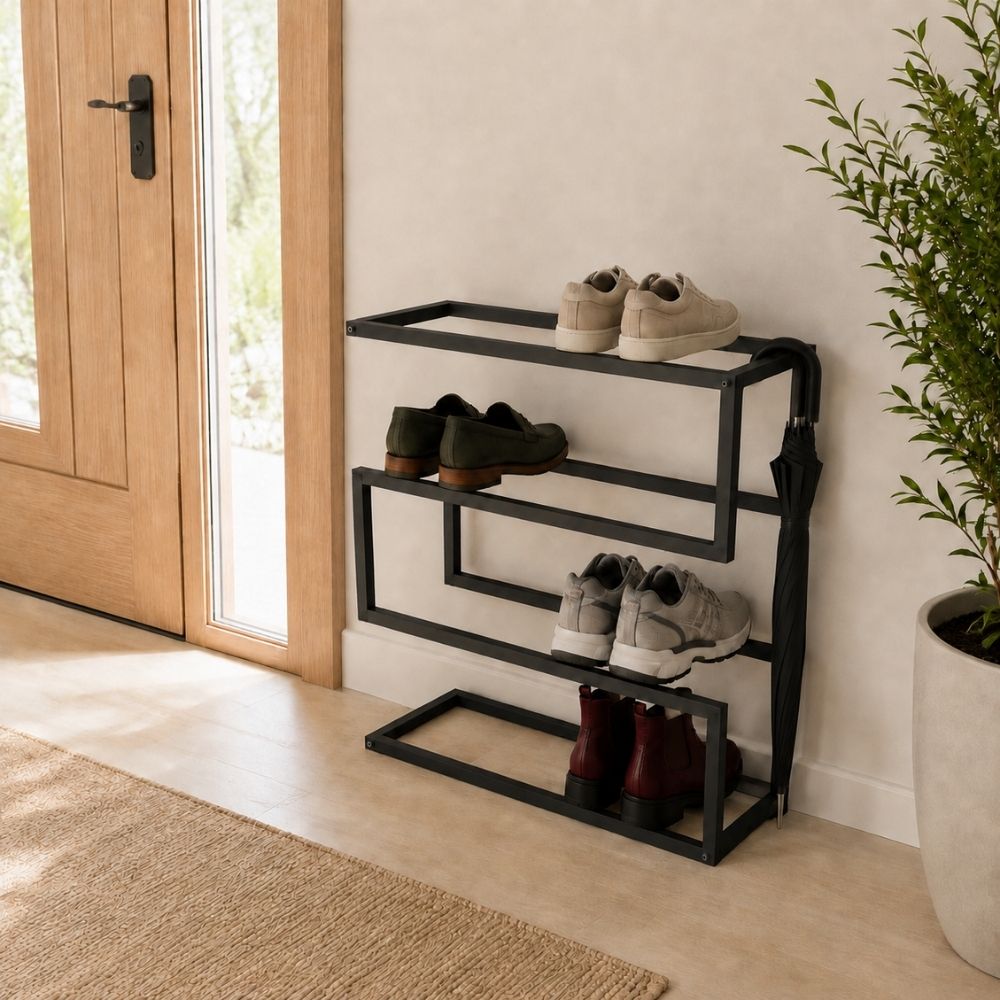
A metal shoe rack keeps everyday footwear visible, reachable, and away from the floor without making an entryway feel crowded. Grandmix brings together compact slipper storage, multi-tier floor racks, wall-mounted shoe organizers, and clean-lined metal designs so you can choose the format that works with your home rather than forcing your routine around a bulky storage piece.
Whether the goal is a calmer front door, a more usable hallway, or a better way to sort slippers near a bedroom or closet, the right shoe storage begins with a clear plan: where people take shoes off, how many pairs are in daily rotation, and how much depth the space can comfortably spare. Browse the collection to find a metal shoe rack that supports that routine while still looking at home in the room.
Choose a Metal Shoe Rack That Fits Your Entryway
Shoe storage is most useful when it sits close to the point of use. In a busy entryway, that may mean keeping daily sneakers, boots, flats, and house slippers in one defined landing zone. In a narrow hall, it may mean using the wall instead of the floor. In a bedroom, a lighter rack can prevent pairs from collecting beside the bed or at the closet door.
Start by looking at the path through the room. A rack should make it easier to arrive and leave, not turn the doorway into an obstacle course. Measure the clear space between the wall and the door swing, as well as the walking path beside the rack. Then think about which pairs genuinely belong there. Seasonal shoes, occasion footwear, and rarely worn pairs can live elsewhere, leaving the shoe rack free for the footwear people reach for every day.
Metal shoe storage works especially well in practical spaces because its open structure keeps a collection easy to scan. You can see when the rack is full, notice when a pair needs to be returned, and avoid digging through a closed cabinet when you are trying to get out the door. The result is a small but helpful routine: shoes have a place, and the floor stays clearer.
Shoe Rack Comparison
| Rack style |
Best for |
How it uses space |
Planning note |
| Wall-mounted shoe rack |
Narrow entrances and compact rooms |
Uses vertical wall area instead of floor depth |
Confirm the wall location, mounting method, and clearance below the rack. |
| Freestanding multi-tier rack |
Households with several everyday pairs |
Uses a defined footprint with stacked storage |
Measure for door swings, baseboards, and a comfortable walking path. |
| Compact slipper rack |
Guest slippers, indoor shoes, or a small daily rotation |
Fits into shallow zones near a door, closet, or bedroom |
Choose it when quick access matters more than storing every pair at once. |
| Angled or open shelf design |
Pairs you want to identify quickly |
Keeps footwear visible from the front |
Consider how larger shoes, boots, or thick soles fit on each level. |
| Rack with a wood top |
Entryways that need a small drop zone as well as shoe storage |
Combines shoe organization with a usable upper surface |
Keep the top clear enough for keys, bags, or the small items used at the door. |
Wall-Mounted vs. Freestanding Shoe Storage
The first decision is usually vertical or floor-based storage. Wall-mounted shoe racks are a strong option when floor depth is limited. They can make a slim passage feel more open by moving shoe storage into an unused section of wall. They are particularly useful near apartment entrances, in small mudroom-style zones, or in homes where a door, radiator, or furniture layout leaves very little floor space available.
A wall-mounted solution does require a little more planning. Measure the height so shoes are easy to reach, make sure the surrounding wall area is not interrupted by switches or trim, and follow the mounting guidance supplied with the chosen product. The rack should be installed using appropriate hardware for the wall type. Keeping a little open space beneath it also makes cleaning simpler and gives the arrangement a lighter visual feel.
Freestanding racks offer flexibility. They are easier to move when a room is rearranged and can work against a wall, beside a closet, or under a console area where the height allows. Multi-tier designs are helpful when several family members use the same entrance because they create more than one level for separating daily footwear. A freestanding rack can also be a better answer for renters or for anyone who prefers not to mount storage to the wall.
Grandmix also offers wall-mounted shoe rack options and freestanding shoe storage for shoppers who already know which approach suits their room.
Plan Capacity, Depth, and Daily Use
Capacity is not just a question of counting shoes. Different pairs occupy different amounts of space: trainers with thick soles, high-top shoes, ankle boots, slides, and soft house slippers all sit differently on a rack. Rather than trying to store every pair you own at the front door, choose a rack for the number of pairs that are realistically worn in a typical week. That keeps the system from overflowing and leaves room for guests or a wet-weather pair.
Depth deserves equal attention. A rack can look slim in a product photo and still feel intrusive in a narrow corridor if the walking route was not measured first. Use painter's tape on the floor to mark the intended footprint before buying. Stand at the door, open it fully, and walk the route you use most often. This simple check reveals whether a compact floor rack, a taller multi-tier design, or a wall-mounted option will feel most natural.
It also helps to divide storage by use. Put the pairs worn most often at the most accessible level. Reserve higher shelves for less-frequent footwear or guest slippers. If children use the rack, a lower level gives them an easy place to return their own shoes. A layout that fits the household's actual habits is far more likely to stay organized than one that only looks tidy on the first day.
Shoe and Slipper Storage for Small Homes
Small spaces do not need more furniture; they need better-defined jobs for the furniture already there. A metal slipper rack can serve as a compact transition point between outdoor shoes and indoor footwear. Place it close to the entrance, bedroom door, or bathroom-adjacent hallway where people naturally change into slippers. Keeping those pairs together makes the room feel intentional and avoids the common pile-up beside the door.
Open shelving is useful in compact homes because it provides a visual limit. Once the designated levels are filled, it is time to rotate footwear rather than adding another loose row on the floor. This encourages a lighter daily setup and makes it easier to wipe or vacuum the area around the rack. For very tight layouts, a vertical wall option may offer the cleanest solution, while a small double-layer or angled stand can be enough for one or two residents.
Consider the rest of the entrance as a complete system. A shoe rack pairs naturally with a wall-mounted coat rack for bags and outerwear, or with other racks and holders that give everyday objects a defined home. When shoes, coats, keys, and bags each have their own place, the entryway becomes easier to reset at the end of the day.
Where to Place a Metal Shoe Rack
By the front door: This is the classic placement for daily shoes. Leave enough room for the door to open and for people to pause comfortably while removing footwear. A compact rack can help establish an entry zone even in an open-plan home.
In a hallway: A narrow hall benefits from shallow storage or a wall-mounted design. Keep the walkway clear, especially if the route connects bedrooms, bathrooms, or stairs. The aim is to reduce visual clutter without narrowing the passage.
Near a closet: A shoe rack can create a useful overflow zone for the pairs that do not fit neatly inside a closet. It also works well as a staging area when getting dressed, allowing you to see several options at a glance.
In a bedroom: A small slipper rack or open shelf near a door can keep indoor footwear in one place. Use this placement for the pairs you want within reach but do not want under the bed or spread across the floor.
In a mudroom-style area: If the home has a utility entrance or family drop zone, choose a rack that supports the heaviest daily use. Keep a mat nearby for wet shoes and allow airflow around footwear before storing it.
How to Measure Before Buying
Take three measurements before choosing a shoe rack: width, depth, and height. Width tells you how much wall or floor run is available. Depth tells you whether the rack will interrupt the walking path. Height matters for multi-tier models and wall-mounted storage, especially where windows, outlets, molding, or hooks are nearby.
- Measure the intended area at floor level and at the height where the rack will sit.
- Check door swings, drawers, closet doors, and any nearby furniture that needs clearance.
- Note the height and shape of the largest shoes you expect to store, not only the smallest pair.
- Decide how many pairs should live on the rack during a normal week.
- Review the product page for the exact dimensions, mounting information, and care guidance before ordering.
For wall-mounted storage, add one final check: confirm that the selected wall and hardware are suitable for the installation. For floor racks, check that the base will sit on a stable, level surface. A few minutes of measuring helps turn a good-looking organizer into a storage piece that truly fits.
Create an Organized Entryway Routine
A shoe rack works best when it becomes part of the arrival routine. Make it easy to follow: shoes come off, each pair goes on a level, and bags or coats go to their own nearby storage. Avoid using the upper surface or top tier as a catch-all for mail, shopping bags, and loose items, since that quickly hides the rack's purpose. A small tray or wall hook can handle those accessories more effectively.
For shared homes, assign a shelf or section to each person where the design allows. For guests, leave one accessible area open rather than asking them to guess where shoes should go. A regular quick reset, such as putting away out-of-season footwear once a week, keeps the entry from slowly turning into a storage pile.
Open metal designs also make it simpler to spot what needs attention. Wipe away dust as part of your usual cleaning routine, allow wet footwear to dry before placing it on the rack, and periodically check that the rack remains stable. Always refer to the product-specific care information for the best guidance for that model.
Find the Right Grandmix Shoe Rack
The Grandmix collection includes practical choices for different homes and routines: minimalist metal shoe racks for a clean-lined entry, multi-tier storage for more active households, wall-mounted organizers for compact areas, and dedicated slipper storage for the places where indoor footwear belongs. Use the product cards above to compare designs and open individual product pages for dimensions, finish details, installation information, and current availability.
For a wider look at home organization, explore bathroom storage, indoor firewood racks, and the rest of the Grandmix storage collection. A thoughtfully chosen rack can make one of the busiest parts of the home feel lighter, clearer, and much easier to use.
Metal Shoe Rack FAQs
How many shoes should a shoe rack hold?
Choose capacity around the pairs used most often, rather than your entire shoe collection. Keeping seasonal or special-occasion footwear elsewhere helps the entryway rack stay easy to use.
Are wall-mounted shoe racks good for small entryways?
They can be an excellent choice when floor depth is limited because they use vertical wall area. Measure carefully and follow the product's installation guidance for the wall type and hardware.
Should I choose open or closed shoe storage?
Open storage is convenient when you want quick visibility and airflow around everyday pairs. Closed storage can hide a larger collection, but it should still suit the room's available depth and ventilation needs.
Can a metal shoe rack be used for slippers?
Yes. Compact, angled, double-layer, and dedicated slipper designs can keep indoor footwear together near an entrance, closet, or bedroom. Review the individual product dimensions to match the rack to the footwear you plan to store.
How do I keep an entryway shoe rack organized?
Store only the current daily rotation, return shoes after use, and rotate seasonal pairs elsewhere. Give each shelf or section a clear purpose so the rack stays useful for everyone in the home.