


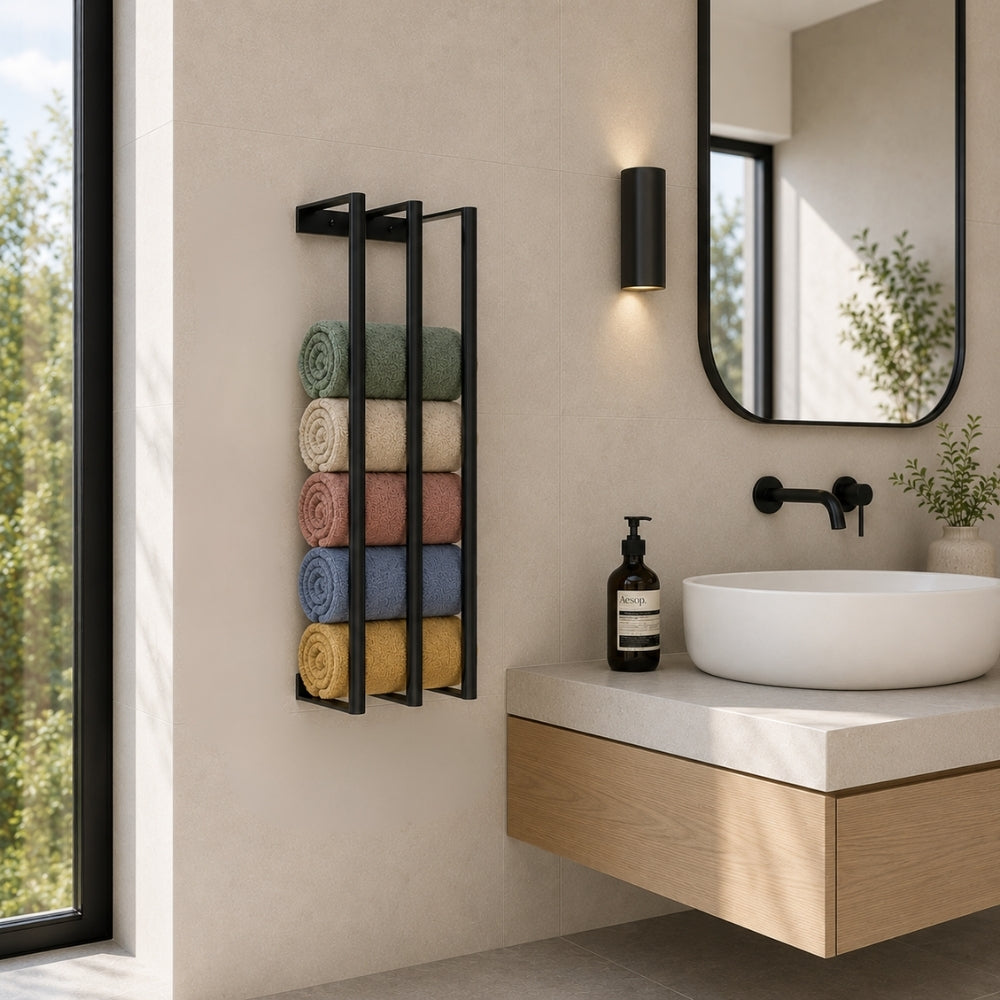
Choosing between a wall-mounted towel rack and a freestanding towel rack sounds simple until you start measuring the bathroom. One option saves floor space and looks built into the room. The other can move where you need it, hold more towels in some layouts, and avoid drilling into tile, drywall, or rental walls. Both can be good choices, but they solve different problems.
The best towel rack is the one that matches the way the room is actually used. A small powder room may need a compact wall-mounted towel holder. A guest bathroom may need visible folded towels and a shelf. A family bathroom may need several towels drying at once. A pool area, laundry room, or shared bathroom may work better with a freestanding towel rack that can be moved, cleaned around, and used in more than one spot.
This guide compares wall-mounted vs freestanding towel racks from a practical, design, and daily-use point of view. It is written for homeowners, renters, apartment dwellers, guest house hosts, and anyone trying to make a bathroom feel more organized without turning the room into a storage closet.
Quick Answer: Wall-Mounted vs Freestanding Towel Rack
A wall-mounted towel rack is usually better for small bathrooms, narrow walls, powder rooms, and clean modern layouts because it uses vertical wall space and keeps the floor open. A freestanding towel rack is usually better when you cannot drill, need flexible placement, store several towels, or want a rack that can move between a bathroom, laundry room, guest room, or pool area.
If the bathroom is short on floor space, start with a wall mounted towel holder for bathroom or a wall shelf from the Bathroom Storage collection. If the main issue is flexibility, towel volume, or no-drill placement, compare freestanding options such as a Modern Towel Rack & Holder or a larger Bath Towel Rack.
Wall-Mounted vs Freestanding Towel Rack Comparison Table
| Feature | Wall-Mounted Towel Rack | Freestanding Towel Rack |
|---|---|---|
| Best for | Small bathrooms, powder rooms, narrow walls, fixed towel zones | Guest bathrooms, laundry rooms, rentals, pool towels, flexible spaces |
| Space use | Uses vertical wall space and keeps floor clear | Uses floor space but can be moved |
| Installation | Requires wall mounting, anchors, screws, or tile-safe planning | Usually no drilling, easier to place |
| Capacity | Good for hand towels, rolled towels, folded towels, or shelf combinations | Often better for several bath towels or temporary towel overflow |
| Cleaning | Floor is easier to sweep or mop when rack is off the ground | Rack must be moved or cleaned around |
| Design effect | Looks integrated and architectural | Looks more like movable furniture or utility storage |
| Rental friendliness | Depends on landlord rules and wall material | Usually more rental-friendly |
| Stability | Stable when mounted properly | Depends on base weight, floor level, and load balance |
| Best internal link | Wall Mounted Towel Rack with Storage Shelf | Modern Towel Rack & Holder |
What Is a Wall-Mounted Towel Rack?
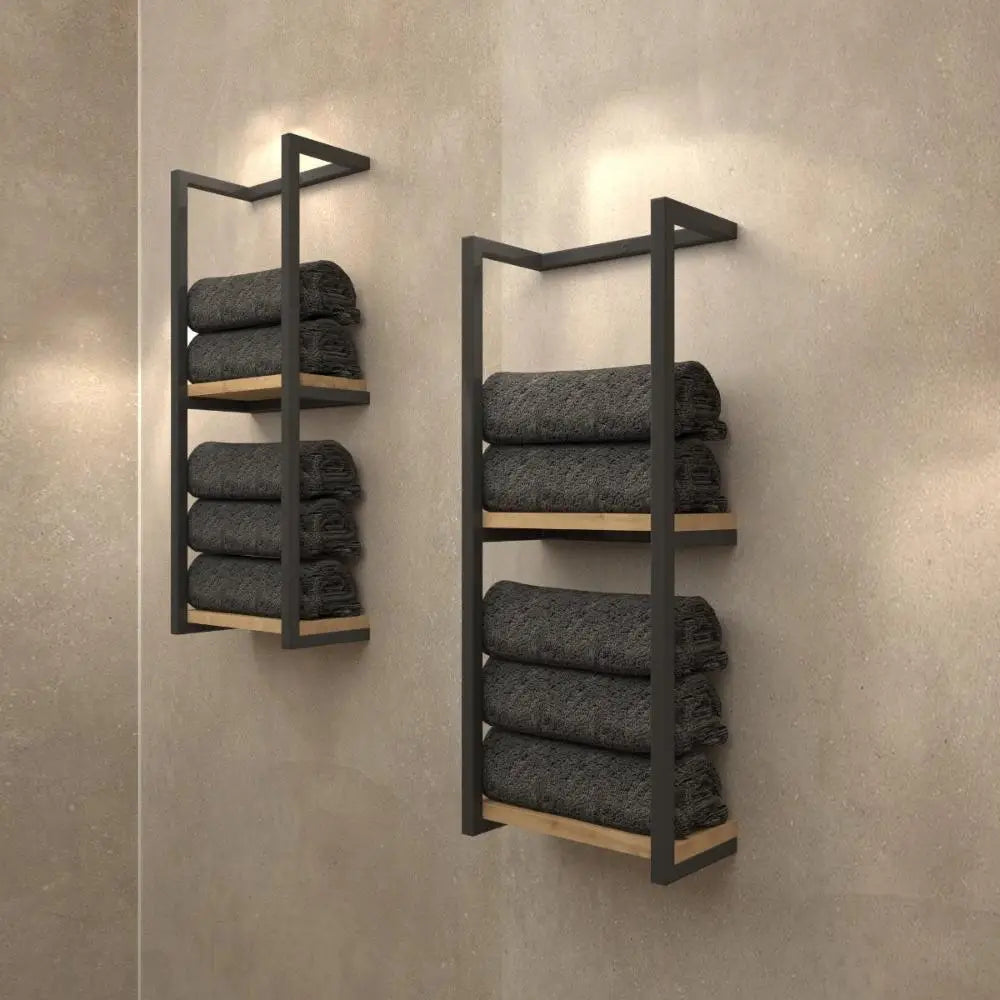
A wall-mounted towel rack attaches to the wall and uses vertical space instead of floor space. It can be a simple bar, a towel holder, a shelf, a multi-tier rack, or a combined shelf and hanging rail. In small bathrooms, that wall placement is the main advantage. The rack does not compete with the toilet, vanity, shower door, hamper, bath mat, or walking path.
Wall-mounted towel storage can also look more intentional because it becomes part of the bathroom architecture. A black metal rack above a toilet, next to a shower, or beside a vanity can connect with mirror frames, faucets, cabinet pulls, shower hardware, or wall decor. That matters because storage is often visible in a bathroom. If the storage looks planned, the whole room feels calmer.
A wall-mounted rack is not automatically better, though. It needs the right wall, the right mounting height, and enough clearance for towels to hang or sit without blocking movement. Tile, plaster, drywall, and masonry all require different installation choices. If the wall is weak or the rack will carry many damp towels, mounting quality matters as much as style.
For a clean fixed towel zone, consider a Wall Mounted Towel Holder for Bathroom. For a storage shelf plus towel function, compare a 2-Tier Bathroom Shelf, Towel Storage for Bathroom or a Wall Mounted Towel Rack with Storage Shelf.

What Is a Freestanding Towel Rack?
A freestanding towel rack sits on the floor and does not need to be attached to the wall. It may have bars, shelves, ladder-style rails, a weighted base, or a wider frame for several towels. The biggest advantage is flexibility. You can place it near the shower, move it beside a bathtub, shift it into a guest room, or use it temporarily when visitors need extra towels.
Freestanding racks are especially useful when drilling is not ideal. Renters may not be allowed to add wall hardware. Homeowners may not want to drill into tile. Some bathrooms simply do not have a good wall location because every wall already has a mirror, window, shower surround, door swing, cabinet, or towel ring. In those cases, a movable rack can solve the problem without forcing the room to change.
The tradeoff is footprint. A freestanding rack takes floor space, so it should not interrupt the walking path or make the bathroom harder to clean. It also needs stable balance. If damp towels are loaded unevenly, the rack should still feel secure. A wider base and good metal construction help.
For flexible storage, compare a Modern Towel Rack & Holder with a larger Bath Towel Rack. If you want to see the broader category, start with the Towel Rack collection.

Which Towel Rack Is Better for a Small Bathroom?
For a small bathroom, a wall-mounted towel rack is usually the better first choice. It keeps the floor open, uses wall space that might otherwise sit empty, and helps the bathroom feel less crowded. In a compact bathroom, even a few inches of floor clearance can change how the room feels.
Small bathrooms have more constraints than large rooms. The door must swing without hitting the rack. The vanity needs knee and hip clearance. The shower door or curtain needs room to move. The toilet area should not feel boxed in. A freestanding rack can work in a small bathroom if it is slim, but it often becomes one more object to move around.
Wall-mounted racks also help organize the eye. A rack above the toilet, beside the vanity, or near the shower creates a defined towel zone. When towels are stacked or hung in one place, the bathroom feels less scattered. This is helpful in apartments, guest baths, and narrow bathrooms where countertop clutter becomes visible quickly.
That said, do not mount a rack just because the bathroom is small. Check towel clearance. A rack that holds folded towels may need more depth than a simple bar. A wall-mounted shelf should not project into a shoulder path. If the rack is near the shower, think about splash and humidity. If it is above the toilet, make sure the height feels reachable.
Which Towel Rack Is Better for Rentals?
For rentals, freestanding towel racks are often easier because they avoid drilling. They can move with you, do not require anchors, and usually do not create repair work when you leave. This is especially useful when bathroom walls are tiled, when the lease limits hardware, or when you are not sure how long you will stay.
Freestanding storage also gives renters flexibility across rooms. A rack can start in the bathroom, move to the laundry room, hold blankets in a bedroom, or support pool towels during warmer months. That multi-room use makes it more practical than a fixture that only works in one wall position.
However, some renters still choose wall-mounted racks when they want a cleaner look and the landlord allows it. If mounting is permitted, choose a location carefully and use hardware appropriate for the wall. Avoid placing a rack where it will be overloaded by heavy wet towels unless the mount is designed for that load.
If you need a no-drill approach, a freestanding rack is the safer default. If you are allowed to install hardware and want a more permanent layout, wall-mounted storage can make even a rental bathroom feel more polished.
Which Option Holds More Towels?
Capacity depends on the design, not only the mounting type. A small wall hook may hold one towel. A wall-mounted shelf can hold several folded or rolled towels. A freestanding ladder rack may hold three or four towels. A larger bath towel rack may hold more if it has multiple bars or shelves.
For daily family bathrooms, think about towel behavior. Do towels need to dry after every shower, or are they mostly stored clean and folded? Hanging towels need air around them. Folded towels need shelf depth. Rolled towels need side support. A rack that looks large may still perform poorly if towels are packed too tightly.
Wall-mounted racks with shelves are useful when the goal is visible clean towel storage. They create a tidy hotel-style look and keep towels off the floor. Freestanding racks are useful when several towels need to dry at once because they often spread towels across multiple rails.
If your household uses many towels, map the routine before choosing. Count daily bath towels, hand towels, guest towels, hair towels, and backup towels. Then decide whether the rack is mainly for drying, storage, display, or overflow. For drying several towels, freestanding often has an advantage. For folded backup towels in a small room, wall-mounted shelves often win.
Airflow and Drying: Which One Performs Better?
Drying performance is about airflow, spacing, and towel contact. A towel dries faster when air can move around it and when the fabric is not folded too tightly. Both wall-mounted and freestanding racks can work well if the design gives towels enough separation.
Wall-mounted bars and open shelves can dry towels effectively when placed in a ventilated area. They are less effective if towels are stacked tightly or pressed against a damp wall. If you use a wall-mounted shelf for folded towels, keep damp towels on a rail or hook instead of burying them under dry towels.
Freestanding racks can be strong for drying because they often hold towels away from the wall and allow air around both sides. A ladder-style or multi-bar rack can give each towel its own rail. The downside is that the rack may be placed in a corner with poor ventilation, or towels may overlap when the rack is overloaded.
For humid bathrooms, choose metal finishes that can handle moisture and avoid designs that trap damp fabric in tight pockets. The recent Grandmix bathroom storage update also highlights rust-resistant, humidity-aware storage as a key direction for modern towel racks. You can read that related context in Grandmix Expands Bathroom Towel Racks and Home Organization Collections.
Cleaning and Maintenance
Cleaning is one of the practical differences people notice after purchase. A wall-mounted towel rack keeps the floor open, which makes sweeping, mopping, or vacuuming easier. There are fewer legs, bases, or corners to clean around. This is valuable in small bathrooms where dust, hair, lint, and towel fibers collect quickly.
Freestanding racks are not hard to clean, but they do add another object to move. If the rack is light, that may not matter. If it is wide, heavy, or loaded with towels, cleaning around it can become annoying. The base shape matters. Simple open bases are easier to wipe around than complex feet or tight corners.
Maintenance also includes checking stability. Wall-mounted racks may need screws tightened occasionally, especially if towels are pulled from one side. Freestanding racks may need a stable flat floor and even loading. If the bathroom floor is uneven, a freestanding rack may wobble unless the base is well designed.
For busy bathrooms, choose the option that reduces friction. If people will constantly bump into a freestanding rack, it is not the right fit. If people will overload a wall shelf, it may not be the right fit either. The best towel rack is the one that stays easy to use after the first week.
Style and Interior Design
Wall-mounted towel racks usually look more built-in. They can create a clean line on the wall and make the bathroom feel more planned. This is especially true with black metal, because it can repeat other dark accents in the room. A black metal towel rack can connect with a mirror frame, shower door, faucet, wall shelf, cabinet pull, or even metal wall decor elsewhere in the home.
Freestanding towel racks look more like furniture. That can be a benefit when the bathroom has space. A freestanding rack can soften a large bathroom, create a spa-like towel station, or make guest towels easy to see. It can also move outside the bathroom when needed, which makes it more flexible as a home organization piece.
The design question is not only about looks. It is about visual weight. A small bathroom often benefits from wall-mounted storage because the floor stays open and the eye sees more room. A larger bathroom can handle freestanding storage because there is enough floor space for the rack to feel intentional.
If your bathroom already has many items on the floor, wall-mounted is usually cleaner. If the walls are crowded but the floor has a calm open corner, freestanding can be better. Match the rack to the empty space the room actually has.
Safety and Stability
Wall-mounted towel racks are stable when installed correctly. The most important factors are wall material, anchor type, screw placement, and load. A rack mounted only into weak drywall may not handle heavy wet towels over time. A rack mounted into studs or with proper anchors will feel much more secure.
Freestanding towel racks depend on base stability. A tall narrow rack can tip if overloaded on one side. A wider base is more stable, especially when children, guests, or pets may brush against it. The rack should sit flat and should not wobble when towels are added or removed.
Safety also depends on placement. Do not put a freestanding rack where someone can trip over the base at night. Do not mount a wall rack where people will hit their shoulder or elbow. Avoid placing towel racks too close to heat sources or tight door swings. Storage should make the room easier, not create one more obstacle.
If you are choosing for a guest bathroom, assume people will not know the room. Make towel placement obvious, reachable, and stable. Guests should not need to guess where clean towels are or how to hang used towels.
Best Use Cases for Wall-Mounted Towel Racks
Choose a wall-mounted towel rack when the bathroom has limited floor space. This is the most common reason. A rack above the toilet, near the shower, beside the vanity, or behind a door can create towel storage without adding a floor object.
Choose wall-mounted when you want a fixed towel zone. A permanent location helps routines. People know where to find towels and where to return them. That is useful in shared bathrooms and guest bathrooms.
Choose wall-mounted when the room has a strong design direction. A well-placed metal rack can support a modern, farmhouse, industrial, minimalist, or transitional bathroom. It can look like part of the room rather than an afterthought.
Choose wall-mounted when cleaning the floor matters. If the bathroom is small, busy, or used daily, floor clearance can save time. It also helps the room feel more open.
Best Use Cases for Freestanding Towel Racks
Choose a freestanding towel rack when drilling is not possible. This includes rentals, tile walls you do not want to pierce, historic homes, or bathrooms where wall hardware would be awkward.
Choose freestanding when towel needs change. Guest visits, pool days, laundry routines, and family schedules can all create temporary towel overflow. A movable rack can handle those changes better than a fixed rack.
Choose freestanding when you have more floor space than wall space. Some bathrooms have mirrors, windows, cabinets, shower glass, and doors on every wall. In that case, a calm corner of floor space may be more useful than forcing a wall solution.
Choose freestanding when you want multi-room use. A rack can hold towels in the bathroom, blankets in a bedroom, throws in a living room, or laundry items near a washer and dryer. That flexibility makes it more than a bathroom accessory.
How to Measure Before Choosing
Start with the towel itself. A bath towel is much larger than a hand towel. If the rack is for drying bath towels, measure the towel width and length. If the rack is for folded towels, measure the stack depth. If the rack is for rolled towels, measure the roll diameter.
Next, measure the available space. For wall-mounted racks, measure wall width, wall height, projection depth, and reach height. Make sure the rack does not interfere with a door, shower, cabinet, mirror, or toilet clearance. For freestanding racks, measure the floor footprint and the walking path around it.
Then check the daily routine. Where do people stand after a shower? Where do they reach for a towel? Where do damp towels go? Where do clean towels wait? The rack should sit near the routine, not just in an empty decorative spot.
Finally, think about maintenance. Can the area be cleaned easily? Can towels dry properly? Can the rack handle the weight? Can children or guests use it without pulling it loose or knocking it over?
Decision Guide: Which One Should You Choose?
Choose a wall-mounted towel rack if the bathroom is small, the wall is suitable, and you want a clean fixed storage zone. This is the best choice for powder rooms, compact apartments, small guest bathrooms, and bathrooms where floor space is already crowded.
Choose a freestanding towel rack if you cannot drill, need flexible placement, or want to store multiple towels in different areas of the home. This is the best choice for rentals, pool areas, laundry rooms, large bathrooms, guest suites, and homes where towel needs change often.
Choose a wall-mounted shelf with a towel rail if you need both folded storage and hanging space. This hybrid approach is often the most efficient for small bathrooms because it creates two functions in one footprint.
Choose a freestanding rack with multiple rails if drying is the main issue. Multiple rails give towels more separation and can help reduce damp towel piles.
If you still are not sure, choose by the constraint that bothers you most. If floor clutter is the problem, go wall-mounted. If wall damage or flexibility is the problem, go freestanding.
Internal Link Map for This Topic
This comparison article should connect naturally to the broader bathroom storage cluster:
- Bathroom Storage for the main category.
- Towel Rack for shoppers comparing towel rack styles.
- Wall Mounted Towel Holder for Bathroom when discussing compact wall storage.
- Wall Mounted Towel Rack with Storage Shelf when explaining shelf plus towel rail storage.
- 2-Tier Bathroom Shelf, Towel Storage for Bathroom when discussing folded towel storage.
- Modern Towel Rack & Holder when discussing flexible freestanding use.
- Bath Towel Rack when discussing higher towel capacity.
- Grandmix Expands Bathroom Towel Racks and Home Organization Collections for the related Grandmix bathroom storage news article.
These links help search engines and answer engines understand the bathroom storage topic cluster. They also help readers move from a general comparison to specific examples without making the article feel like a sales page.
FAQ: Wall-Mounted vs Freestanding Towel Rack
Is a wall-mounted towel rack better than a freestanding towel rack?
A wall-mounted towel rack is better for small bathrooms, fixed towel zones, and clean floor space. A freestanding towel rack is better when you cannot drill, need flexible placement, or want to move towel storage between rooms.
What type of towel rack is best for a small bathroom?
A wall-mounted towel rack is usually best for a small bathroom because it uses vertical wall space and keeps the floor open. A wall-mounted shelf with a towel rail can be especially useful when you need both folded towel storage and hanging space.
Are freestanding towel racks good for rentals?
Yes. Freestanding towel racks are often good for rentals because they do not require drilling and can move with you. They are also useful when tile walls or lease rules make wall mounting difficult.
Which towel rack dries towels faster?
The drying speed depends on airflow and spacing. Freestanding racks often allow air around both sides of the towel, while wall-mounted bars can also dry towels well if they are not overloaded or pressed against a damp wall.
Can a wall-mounted towel rack hold bath towels?
Yes, a wall-mounted towel rack can hold bath towels if it is properly mounted and sized for the towel weight. Use the right anchors or studs, especially for heavy wet towels.
Where should a towel rack be placed in a bathroom?
Place a towel rack where towels are easy to reach after washing or showering, but not where it blocks doors, cabinets, toilets, or walking paths. The best location supports the routine and leaves towels enough airflow.
Final Takeaway
The wall-mounted vs freestanding towel rack decision is really a space and routine decision. Wall-mounted racks are best when the bathroom needs floor clearance, a fixed towel zone, and a clean built-in look. Freestanding racks are best when the room needs flexibility, no-drill storage, or more towel capacity that can move as the household changes.
For most small bathrooms, start with wall-mounted storage. For rentals, guest areas, laundry rooms, and larger bathrooms, compare freestanding racks. If you need both storage and drying in one compact place, a wall-mounted shelf with a towel rail can be the best middle path.
The right towel rack should make the bathroom easier to use every day. It should give towels a clear home, help damp fabric dry, support the room's style, and reduce clutter without adding another problem to solve.

Leave a comment
This site is protected by hCaptcha and the hCaptcha Privacy Policy and Terms of Service apply.