


Large Wall Art vs Gallery Wall: Which Is Better for Modern Homes?
Large wall art and gallery walls both solve the same design problem: they help a blank wall feel deliberate. But they do not create the same kind of room. A large single artwork creates one clear focal point. A gallery wall creates rhythm, story, and layered personality. One asks the eye to land. The other asks the eye to explore.
This difference matters because wall decor is not only decoration. It affects how a room feels, how large the wall appears, how calm or busy the space becomes, and how easily the home can be maintained. A living room with one strong metal wall art piece can feel architectural and composed. A hallway with a gallery wall can feel collected and personal. A bedroom may need one quiet focal point, while a staircase may benefit from a group of framed memories or small works.

The simplest rule is this: choose large wall art when the room needs scale, clarity, visual calm, and a strong focal point. Choose a gallery wall when the room needs personality, storytelling, collected images, or flexible arrangement over time. In modern homes, large wall art is often better for clean rooms, open-plan spaces, fireplace walls, dining rooms, offices, and areas where too many small items would feel noisy. Gallery walls are often better for corridors, stairways, family spaces, creative rooms, and walls where personal history matters.
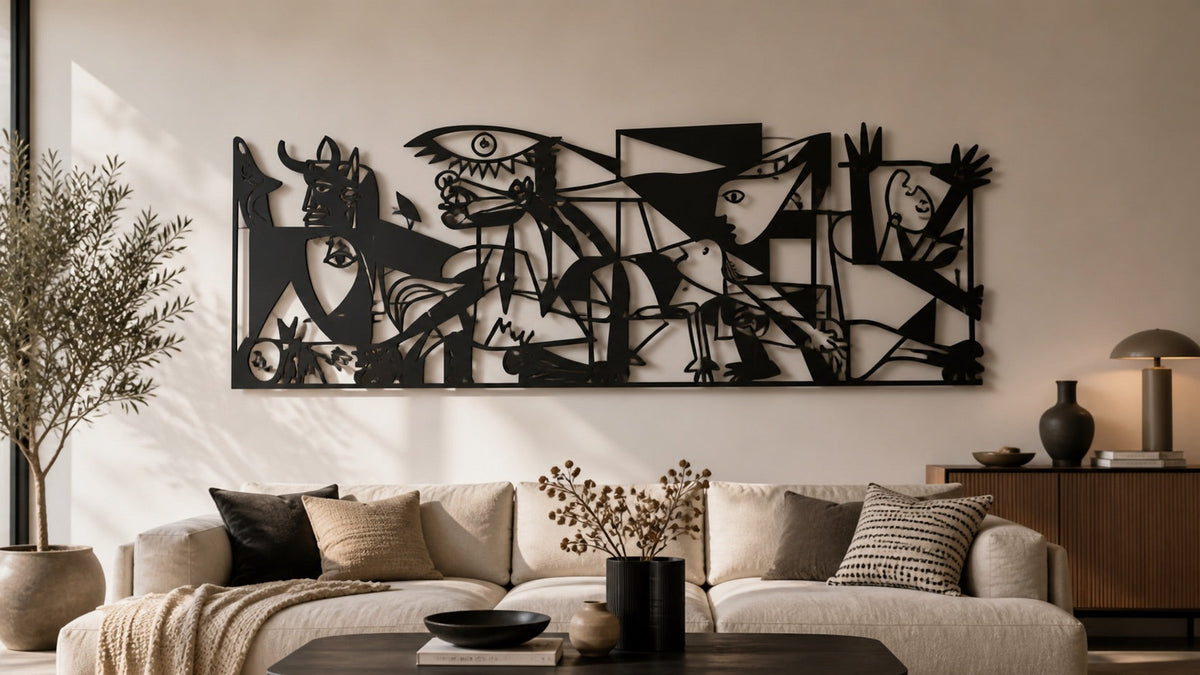
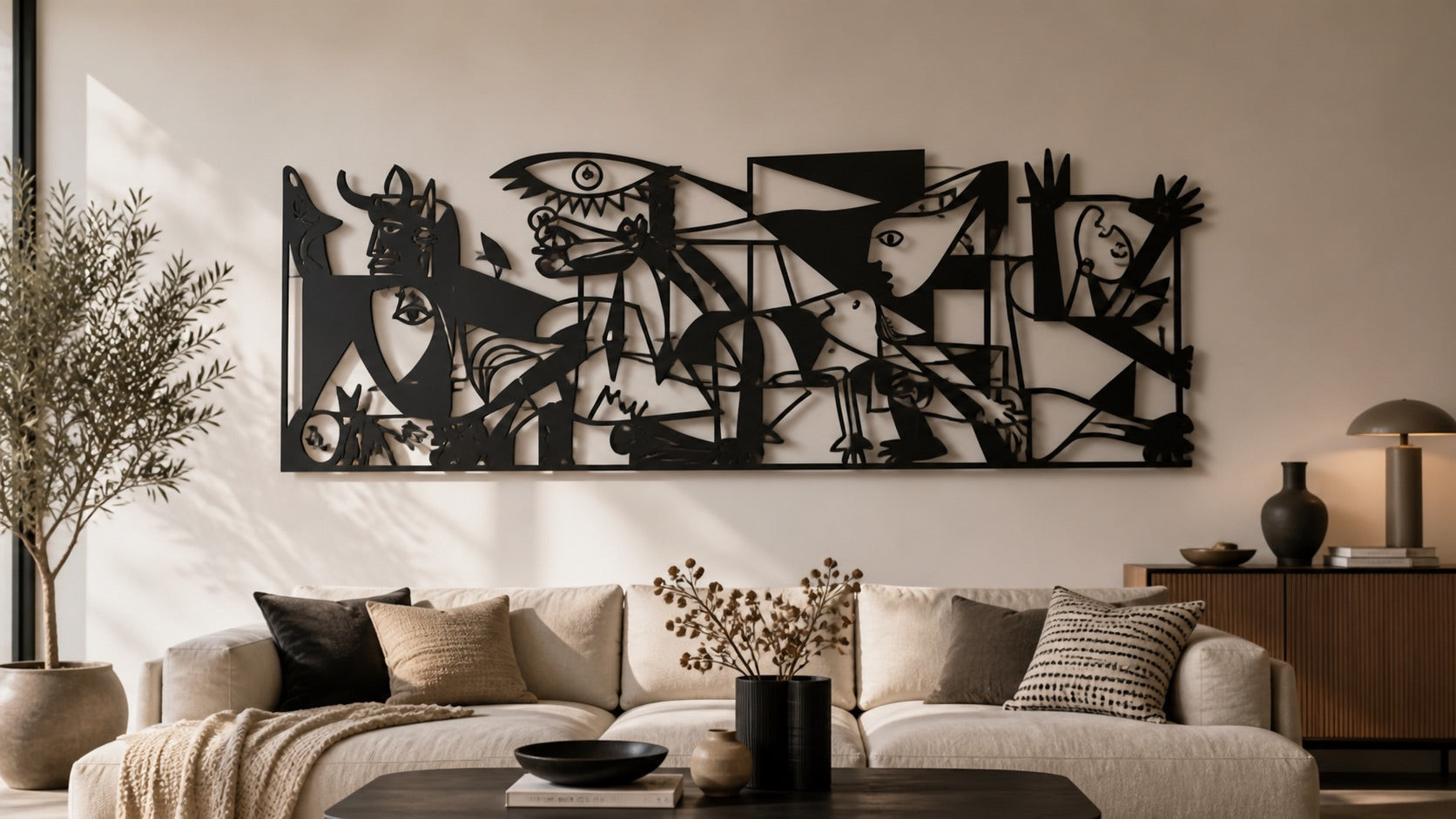
For Grandmix readers exploring dimensional wall decor, the wall decor and wall art collection is a useful reference point. It shows how one strong metal piece can act like a visual anchor rather than another small framed item added to a crowded wall.
Quick Answer: Is Large Wall Art or a Gallery Wall Better?
Large wall art is usually better when the room needs one confident statement, simple maintenance, modern structure, or a calm focal point. A gallery wall is usually better when the room needs layered personality, family photos, collected prints, small art pieces, or a flexible arrangement that can evolve.
If the wall is above a sofa, console table, bed, fireplace, dining bench, or desk, one large artwork often creates a cleaner result. The scale feels intentional, and the room does not need many small decisions. If the wall is in a hallway, stairwell, family room, or creative workspace, a gallery wall can feel warmer and more personal because the eye has time to move across multiple pieces.
The decision should not be based only on personal taste. It should also consider wall size, furniture width, ceiling height, lighting, cleaning, installation effort, and the amount of visual detail the room already has. A room with patterned rugs, open shelving, plants, books, and decorative objects may benefit from one large piece. A very plain hallway may benefit from a gallery wall because the wall has room for detail.
Large Wall Art vs Gallery Wall Comparison Table
| Factor | Large Wall Art | Gallery Wall |
|---|---|---|
| Best for | Strong focal points, modern rooms, clean layouts, statement walls | Storytelling, personal collections, hallways, staircases, flexible decor |
| Visual effect | Calm, bold, architectural, easy to understand | Layered, detailed, personal, visually active |
| Installation | Usually one main placement decision | Requires spacing, alignment, grouping, and more planning |
| Maintenance | Easier to dust and keep visually clean | More frames or objects to dust, straighten, and update |
| Small rooms | Good when one piece keeps the wall calm | Good if pieces are small and spacing is controlled |
| Large rooms | Excellent above sofas, fireplaces, dining tables, and consoles | Works if the wall can support many pieces without looking scattered |
| Best style match | Minimalist, modern, industrial, contemporary, transitional | Eclectic, family-focused, collected, creative, traditional-modern mix |
| Main risk | Can look too small if scale is wrong | Can look cluttered if spacing or frame style is inconsistent |
| Best material choice | Metal wall art, oversized canvas, sculptural art, one framed piece | Framed prints, photos, small canvases, sketches, mixed media |
| Quick rule | Use one piece when the room needs a visual anchor | Use many pieces when the wall needs narrative and movement |
This table shows why the answer changes by room. Large wall art is not automatically more sophisticated, and gallery walls are not automatically cluttered. Each format has a role. The strongest choice is the one that matches the wall's job.

What Large Wall Art Does Best
Large wall art is strongest when a room needs one clear visual anchor. In many modern homes, the furniture layout is already simple: a sofa, a coffee table, a media unit, a dining table, or a console. A large wall can feel empty above these pieces if the art is too small. One oversized piece gives the wall a center of gravity.
This is especially true with metal wall art. A large metal piece can introduce structure without covering the wall with color. It can use negative space, shadow, line, and shape to create a dimensional focal point. This makes it useful in rooms where the wall color is already part of the design. Instead of hiding the wall behind many frames, the art lets the wall breathe.
Large wall art also reduces decision fatigue. A gallery wall requires many choices: frame size, frame color, image order, spacing, alignment, and the relationship between each piece. One large artwork needs careful scale and placement, but once those are solved, the wall reads quickly. The room feels finished without requiring the viewer to decode a collection.
Another strength is maintenance. One piece is easier to dust, easier to align, and easier to live with. In busy homes, this matters. A wall with twelve frames may look beautiful on day one but can become crooked, dusty, or visually heavy over time. A large metal artwork or single statement piece can remain cleaner with less effort.
Large wall art is also useful when a room already has open storage, shelves, books, plants, or many visible objects. If the walls add too much detail on top of existing detail, the room can become tiring. This connects to the same design logic in Grandmix's guide to open storage vs closed storage: visible elements should be edited carefully. If a room already has many visible items, one large piece can bring order.

What Gallery Walls Do Best
Gallery walls are strongest when a home needs story. A gallery wall can combine family photos, travel prints, sketches, small artworks, typography, vintage pieces, mirrors, or meaningful objects. It turns the wall into a collection instead of a single statement.
This can be powerful in spaces where people move slowly or pass by often. Hallways, staircases, landings, home offices, reading corners, and family rooms are natural places for gallery walls. The viewer can notice a different piece each time. The wall becomes less like a focal point and more like a memory layer.
Gallery walls are also flexible. A single large artwork is usually chosen for one wall and one scale. A gallery wall can grow over time. One frame can be replaced. A new photo can be added. A seasonal print can move in. This makes gallery walls appealing for households that like change or want the home to show personal history.
Another benefit is budget control. A large artwork can sometimes require a larger upfront decision. A gallery wall can be built slowly from smaller pieces. It can mix affordable prints with meaningful photographs and one or two higher-value pieces. The total result can feel rich even if each individual piece is modest.
The risk is visual noise. A gallery wall with too many frame colors, random spacing, weak alignment, or unrelated images can make a room feel messy. This is especially true in rooms that already have patterned rugs, open shelves, decorative storage, or many small objects. A gallery wall needs editing. Without editing, it becomes clutter on the wall.
Which Looks More Modern?
Large wall art usually looks more modern by default because modern interiors often rely on scale, restraint, and clear focal points. One large metal artwork above a sofa or dining console can feel clean and architectural. It repeats the language of modern design: fewer objects, stronger lines, and more breathing room.
Gallery walls can also look modern, but they need discipline. A modern gallery wall usually uses consistent spacing, a limited frame palette, and a clear visual system. Black frames with white mats can look sharp. Thin metal frames can feel contemporary. A grid layout can make multiple pieces feel ordered. An organic gallery wall can still work, but it requires a good sense of balance.
If the room has minimalist furniture, large wall art is often the safer modern choice. If the room has layered textiles, books, personal objects, and a warm collected feeling, a gallery wall can fit naturally. The issue is not whether one format is modern and the other is not. The issue is whether the format supports the room's existing rhythm.
A useful test is to step back and ask what the room is missing. If it lacks strength, choose one large piece. If it lacks personality, consider a gallery wall. If it lacks both, start with one dominant piece and add only a small supporting group elsewhere.
Which Is Better for Living Rooms?
Living rooms often benefit from large wall art because the main wall needs a clear anchor. The space above a sofa, fireplace, media console, or sideboard is usually seen from multiple angles. One strong piece helps the room feel organized from the moment someone enters.
Large wall art is especially useful above a sofa. A common mistake is hanging several small pieces that do not relate to the sofa width. The wall then looks busy but still unfinished. A large artwork, especially one that is roughly two-thirds the width of the furniture below it, usually feels more intentional.
A gallery wall can work in a living room too, but it should be used where detail is welcome. A side wall, reading corner, piano wall, or family photo area may be better than the main focal wall. If the gallery wall competes with the television, fireplace, open shelves, and large furniture, the room may feel visually crowded.
For modern living rooms, a hybrid method often works best: one large statement piece on the primary wall and a smaller gallery grouping in a secondary zone. This lets the room have both structure and personality without asking every wall to perform the same job.
Which Is Better for Dining Rooms?
Dining rooms often need a focal point that feels calm from a seated position. Large wall art is usually strong here because diners look at the wall for long periods. One large piece can set the mood without creating too much visual distraction.
Metal wall art can be especially effective in dining rooms because it pairs well with lighting, table legs, hardware, and sculptural centerpieces. It can create a restaurant-like feeling without feeling overly decorated. The shadows and cut lines can change subtly as evening light changes.
Gallery walls can work in dining rooms when the space is casual or personal. Family photos, food-related prints, travel images, or small artworks can make a dining area feel warm. But in a formal dining room, a busy gallery wall may distract from the table setting, lighting, or architecture.
If the dining room is narrow, one large horizontal artwork may make the wall feel longer and more balanced. If the dining room has a long blank side wall and simple furniture, a gallery wall can add life. The choice depends on whether the dining room should feel composed or conversational.
Which Is Better for Bedrooms?
Bedrooms usually need calm. For that reason, large wall art is often better above a bed than a busy gallery wall. One large piece can anchor the bed and make the room feel complete without adding too much visual activity.
Canvas, metal wall art, or a framed textile-inspired piece can all work above a bed, depending on the mood. If the bedroom is soft and neutral, metal wall art can add definition. If the bedroom is already hard-edged or minimal, a softer oversized artwork may bring warmth. The related Grandmix guide on metal wall art vs canvas prints goes deeper into that material choice.
Gallery walls can work in bedrooms, but they are better away from the bed. A dresser wall, vanity wall, or reading corner can support smaller framed pieces. Above the headboard, too many frames can feel visually restless. Bedrooms should not ask the eye to work too hard.
The exception is a very restrained gallery wall. A symmetrical pair, a clean grid of four, or three quiet pieces in matching frames can still feel restful. But if the goal is a calm modern bedroom, one large artwork usually wins.
Which Is Better for Hallways and Staircases?
Hallways and staircases are natural homes for gallery walls. These spaces are transitional. People move through them, and the walls often have no furniture below. A gallery wall can add story without interrupting a main seating area.
A staircase gallery wall can follow the line of the stairs. A hallway gallery wall can create rhythm along a long corridor. Family photos, travel prints, small art pieces, and personal collections all make sense in these spaces because the viewer can experience them in sequence.
Large wall art can also work in hallways, especially at the end of a corridor. A single piece on an end wall creates a destination and can make the hallway feel designed. In a narrow hallway, one slim metal artwork may be better than many frames that project from the wall.
The best approach is often mixed. Use a gallery wall where the viewer moves alongside the wall. Use large wall art where the viewer looks directly at the wall from a distance.
Which Is Better for Small Rooms?
Small rooms need careful wall decisions. It may seem logical to use small art in a small room, but that often makes the space feel more fragmented. One larger piece can make the room feel more confident and less cluttered.
Large wall art works in small rooms when it has enough breathing room. A slim metal piece with open negative space can decorate the wall without making it feel heavy. This is useful in powder rooms, small offices, compact bedrooms, and apartments where floor space is limited.
Gallery walls can work in small rooms if the layout is controlled. Too many small frames can make the room feel busy. A small grid of matching frames or a narrow vertical arrangement can be effective, but random collections may overwhelm the space.
Ask whether the room already has many visible items. If it has open shelves, visible storage, plants, books, or patterned textiles, choose one large artwork. If the room is plain and needs personality, a small gallery wall may help. This is similar to the storage logic in Grandmix's guide to wall shelves vs cabinets: visibility is useful only when it is controlled.
Which Is Easier to Install?
Large wall art is usually easier to plan but can require more care when mounting. There may be one or two hanging points, but the placement must be right. The center height, furniture relationship, and horizontal alignment matter. If the piece is heavy, the wall type and hardware matter too.
Gallery walls are usually harder to plan because many pieces must relate to one another. Even lightweight frames can be frustrating if spacing is inconsistent. A gallery wall should be tested on the floor or with paper templates before holes are made. This prevents the common problem of a wall that slowly drifts out of alignment.
For renters, both formats require caution. A large piece may need stronger anchors. A gallery wall may require many holes. Renters should check lease rules and wall material before committing. If drilling is limited, one large lightweight piece may be less invasive than twelve separate frames.
The installation choice should match patience. If the household wants a quick, clean result, large wall art is usually easier. If the household enjoys arranging, measuring, collecting, and evolving the display, a gallery wall can be rewarding.
Which Is Easier to Keep Clean?
Large wall art is easier to keep clean because there is less surface interruption. One metal piece, canvas, or framed artwork can be dusted as part of a normal cleaning routine. There are fewer edges, fewer frames, and fewer small ledges.
Gallery walls require more maintenance. Each frame can collect dust. Frames can shift over time. Glass can show fingerprints. Small gaps can trap dust. If the gallery wall includes objects, shelves, or mixed materials, cleaning becomes more involved.
This does not mean gallery walls are impractical. It means they should be placed where maintenance feels reasonable. A gallery wall in a hallway may be easy enough. A gallery wall above a frequently used bench, near a kitchen, or in a high-dust area may need more attention.
For households that prefer low-maintenance decor, large wall art is usually the better choice. For households that enjoy rotating photos and updating displays, the extra care may be worthwhile.
Common Mistakes With Large Wall Art
The biggest mistake with large wall art is choosing a piece that is still too small. A piece can be large in the store and still look undersized above a wide sofa or dining table. Scale should be judged against the furniture and wall, not against the artwork by itself.
Another mistake is hanging the piece too high. Wall art should relate to the furniture below it and to eye level. If it floats too far above the sofa or console, the wall can look disconnected. A large piece should feel anchored, not stranded.
A third mistake is ignoring material repetition. Metal wall art looks best when at least one other metal detail in the room speaks to it: lighting, table legs, curtain rods, hardware, fireplace tools, or frames. This repetition helps the piece feel intentional.
Finally, avoid treating large wall art as the only decorative object in the room. A strong piece still needs support from lighting, furniture placement, and texture. The artwork anchors the wall, but the room finishes the story.
Common Mistakes With Gallery Walls
The biggest gallery wall mistake is weak spacing. If the gaps between frames are random, the wall feels accidental. Consistent spacing creates order even when the artwork varies.
Another mistake is using too many frame styles. A gallery wall can mix frames, but the mix should feel deliberate. If every frame has a different color, width, finish, and mat style, the wall may look chaotic. Limit the palette or repeat at least one element.
A third mistake is starting without a center. Even an organic gallery wall needs hierarchy. One larger piece, one central image, or one strong visual anchor helps the arrangement feel composed.
Finally, avoid placing a busy gallery wall in a room that is already visually busy. If the room has open shelves, patterned upholstery, many small objects, and colorful decor, a gallery wall may push it too far. Use one large piece instead, or move the gallery wall to a quieter hallway.
The Hybrid Method: One Hero Piece Plus a Small Supporting Wall
Many homes do not need to choose only one format. The best approach is often hybrid: one large hero piece in the main room and a smaller gallery wall in a secondary area.
For example, a living room can use one large metal wall art piece above the sofa and a small gallery wall in the hallway. A bedroom can use one calm artwork above the bed and three framed prints above a dresser. A dining room can use one large piece near the table and a personal photo grouping near a sideboard.
This method creates hierarchy. The home has a clear focal point, but it also has personal layers. The key is not to make every wall equally loud. Some walls should anchor. Some should tell stories. Some should stay quiet.
For Grandmix-style interiors, a large metal wall art piece can act as the hero. Smaller frames, storage pieces, shelves, and decorative objects can support the room without competing. The result feels collected but still modern.
FAQ
Is large wall art better than a gallery wall?
Large wall art is better when the room needs one strong focal point, clean structure, and easier maintenance. A gallery wall is better when the wall needs personality, storytelling, and a flexible collection of smaller pieces.
Are gallery walls outdated?
Gallery walls are not outdated, but cluttered gallery walls can feel dated. A modern gallery wall needs consistent spacing, a controlled frame palette, and a clear visual hierarchy.
What size should large wall art be above a sofa?
A good starting point is artwork that is about two-thirds the width of the sofa or furniture below it. The exact size depends on ceiling height, wall width, and the visual weight of the piece.
Is metal wall art good for large walls?
Yes. Metal wall art can work well on large walls because it adds structure, shadow, and dimension without covering the entire wall with printed color. It is especially useful in modern living rooms, dining rooms, offices, and entryways.
Can I mix large wall art and a gallery wall in the same home?
Yes. Use large wall art as the main focal point in one room and a gallery wall in a hallway, staircase, office, or secondary wall. This keeps the home balanced instead of making every wall compete.
Which wall decor is easiest to maintain?
Large wall art is usually easier to maintain because there are fewer frames, edges, and glass surfaces to clean. Gallery walls require more dusting, straightening, and occasional editing.
Final Takeaway
Large wall art and gallery walls both have a place in modern homes, but they create different effects. Large wall art brings scale, calm, structure, and a clear focal point. A gallery wall brings story, movement, memory, and flexibility.
Choose large wall art when the room needs to feel composed. Choose a gallery wall when the wall needs to feel personal. Use one large piece in main focal areas such as living rooms, dining rooms, bedrooms, offices, and fireplace walls. Use gallery walls in hallways, staircases, family spaces, and secondary zones where detail is welcome.
The strongest interiors use wall decor with hierarchy. One wall can lead. Another can support. Another can stay quiet. When the wall decor format matches the room's real job, the home feels designed rather than filled.

Leave a comment
This site is protected by hCaptcha and the hCaptcha Privacy Policy and Terms of Service apply.